

TABLE OF CONTENTS
ARTICLES
TITLES / DESCRIPTION
PREAMBLE OF THE ORGANIZATION
NAME, DOMICILE, AND RECOGNITION OF THE ORGANIZATION
VISION, MISSION, GOALS, OBJECTIVES, AND CORE VALUES
MEMBERSHIP, APPLICATION REQUIREMENTS, AND QUALIFICATIONS
FUNCTIONS AND LEGAL PROCEDURES OF THE AURUM INNOCATIONS AND DEVELOPMENT ORGANIZATION
COMPOSITION OF RANKS AND TERM OF OFFICE OF THE AIDO OFFICERS AND APPOINTEES
DUTIES AND RESPONSIBILITIES OF THE AIDO OFFICERS
COMPOSITION OF SEPARATED INTERNAL OFFICES OF THE AIDO AND IT'S COMMITTEE AND COMMITTEE MEMBERS
FUNCTIONS, DUTIES, AND RESPONSIBILITIES OF THE COMMITTEE AND COMMITTEE MEMBERS
BUREACRATIC NOMINATION ON APPOINTIVE AND ELECTIVE POSITIONS
MEETINGS, QOURUM, INTERNAL AND EXTERNAL RULES
SUSPENSION, TERMINATION, IMPEACHEMENT, AND VACANCY OF POSITION AND LEGAL PROCEDURES OF OCCUPATION
GRIEVANCE PROCEDURES AND LEGAL PROCESS
PREPARATION AND CONDUCT OF ACTIVITIES, PROJECTS, AND PROGRAMS
INTELLECTUAL PROPERTY AND PRIVACY PROTECTION POLICY
INTERNAL AND EXTERNAL PARTNERSHIP
OFFICIAL LOGO
AURUM LEGAL POSSESSION OF INVENTORIES AND RESOURCES
CODE OF HONOR AND COMMITMENT AGREEMENT
ORGANIZED DISTRIBUTION OF DOCUMENTS AND IT'S STANDARD PROCEDURES
AMENDMENTS AND REVISION OF ORGANIZATIONAL LAWS
DISSOLUTION AND RESET PROTOCOL
EFFECTIVITY OF THE SYSTEMATIC CODE AND BY-LAWS
PREAMBLE
We, the students in the Institute of North Eastern Mindanao State University - Tandag Main Campus of Surigao del Sur, guided by our faith and commitment to our future, recognize the importance of a strategic and innovative organization and the development of students as future leaders and entrepreneurs. Therefore, we adopt this Systematic Code and Bylaws of the Aurum Innovations and Development Organization to advance, implement, and maintain our goals and aspirations. We aim to uphold the principles of innovation, technology, independence, control, and prioritize the advancement for the welfare of all students of this university while preserving the academic and non-academic standards of North Eastern Mindanao State University (NEMSU) - Tandag Main Campus.
ARTICLE I
NAME, DOMICILE, AND RECOGNITION OF THE ORGANIZATION
Section 1. Name of the Organization - This organization shall be officially known and designated as the Aurum Innovations and Development Organization, hereinafter referred to as AIDO or Aurum.
Section 2. Official Domicile - The official domicile of AIDO shall be within the jurisdiction of North Eastern Mindanao State University (NEMSU) – Tandag Main Campus, subject to the approval and supervision of the Office of Student Welfare and Development (OSWD), and in compliance with the guidelines stated in the University Student Handbook.
Section 3. Digital Office and Online Presence - AIDO shall maintain an official digital office, including a designated website or online platform, to facilitate internal and external communications, project coordination, and partnership engagements. This digital presence shall be monitored professionally and ethically by the OSWD and shall be registered under the name of the organization, subject to university ICT policies and the oversight of OSWD.
Section 4. Recognition - Aurum Innovations and Development Organization (AIDO) shall be recognized as an independent student organization under the university’s regulations, classified as a service-based and innovation-focused organization.
ARTICLE II
VISION, MISSION, GOALS, OBJECTIVES, AND CORE VALUES
Section 1. Vision - The Aurum Innovations and Development Organization (AIDO) envisions itself as an advanced student-led organization committed to technological innovations, advance and initiative research, strategic partnerships, and development. It aspires to become a catalyst for student empowerment, enabling learners to discover and go beyond their unique potentials in service of academic and societal advancement.
Section 2. Mission - AIDO’s primary mission and why it exists, is to provide student-centered services through initiatives focused on innovation, collaborative research, impactful development programs, and strategic partnerships within and beyond the university. In alignment with the principles of North Eastern Mindanao State University (NEMSU) and in accordance with the University Student Handbook, AIDO seeks to preserve a culture of intellectual growth, practical solutions, and transitional leadership among its members.
Section 3. GOALS - The Aurum Innovations and Development Organization (AIDO) shall pursue the following goals:
-
To train, equip, and empower students who aspire to become future professionals by providing access to tools, strategies, innovations, and initiatives that transform visions into reality — fostering higher productivity and purpose-driven success.
-
To support students and members in overcoming academic and professional challenges, such as time constraints and limited access to educational resources, through collaborative learning and technical assistance.
-
To function as an independent, service-based student organization that actively addresses student concerns, advocates innovative solutions, and supports the university's continuous adaptation to technological and developmental advancements.
-
To deliver meaningful services and collaborative programs to its official partners, as well as internal and external institutional alliances, in pursuit of shared academic and developmental goals.
-
To promote continuous and experiential learning, not only within the organization but also through engagements with its partner organizations, networks, and affiliated institutions.
Section 4. OBJECTIVES - The Aurum Innovations and Development Organization (AIDO) shall pursue the following objectives:
-
To provide timely and effective support to students by addressing their academic and developmental needs with excellence, ensuring that expectations are not only met but consistently exceeded.
-
To uphold academic integrity and moral standards by ensuring that all assistance and services provided to students and faculty comply with the ethical guidelines, academic honesty policies, and the Code of Conduct of North Eastern Mindanao State University (NEMSU) – Tandag Main Campus.
-
To deliver innovative, research-driven, and technology-based solutions to students, instructors, and institutional partners, keeping them equipped with modern tools and strategies that promote academic success and leadership in their respective fields.
-
To maintain a high standard of professionalism and service quality in all engagements with students, faculty, and partners, ensuring that operations are efficient, transparent, and accountable.
-
To foster learning through service by drawing insights and intelligence from all rendered programs and activities, thereby sustaining the organization’s growth and enhancing its capacity to serve.
-
To serve, represent, and advocate for student welfare, ensuring that student concerns are heard, protected, and addressed through proactive, ethical, and innovative initiatives.
Section 5. CORE VALUES - The Aurum Innovations and Development Organization (AIDO) upholds the following core values as foundational principles of its vision, mission, and operations:
-
Advancement - AIDO is committed to continuous growth by embracing modern strategies, technologies, and best practices that align with current academic and developmental trends.
-
Innovation - AIDO fosters a culture of creativity and forward-thinking by integrating technological solutions and research-based practices to improve student services and organizational impact.
-
Strategic Solutions - AIDO delivers effective, research-informed, and proactive responses to challenges faced by students, faculty, and institutional partners through critical thinking and innovation.
-
Development - AIDO supports personal, academic, and professional growth by creating programs and partnerships that equip students with the tools and experiences needed to thrive.
-
Service - AIDO is dedicated to serving the academic community with professionalism, inclusivity, and excellence—ensuring that the needs of students, instructors, and partners are consistently met.
ARTICLE III
MEMBERSHIP, APPLICATION REQUIREMENTS AND QUALIFICATIONS
Section 1. Qualifications - All bona fide and willing students of North Eastern Mindanao State University (NEMSU) are eligible to become members of the Aurum Innovations and Development Organization (AIDO), regardless of college, department, year level, academic program and background, provided they comply with the organization’s membership policies.
Section 2. Requirements - To apply for membership, the following requirements must be submitted:
-
1x1 ID photo (soft copy)
-
Complete legal name
-
Student ID number
-
Certificate of Registration (latest semester)
Section 3. Data and Records - The Executive for Internal Affairs and the Executive for Biometric Systems shall be jointly responsible for the collection, protection, and secure handling of member data. All personal information shall be kept confidential and shall be used solely for organizational purposes, in accordance with the university’s data privacy policies and ethical standards.
Section 4. Membership Verification - All applications shall undergo a verification process to ensure authenticity of submitted documents and information. The Executive for Internal Affairs shall examine all submitted documents. Verified applicants will be pinned as "Pre-Approved Members" pending evaluation.
Section 5. Membership Evaluation - All pre-approved applicants shall undergo a Membership Evaluation, which involves the authentication and verification of all submitted documents to ensure their legitimacy and accuracy. This process is conducted by the Membership Committee, with support from the Executive on Internal Affairs and the Executive on Database Systems. Once verified, applicants will be subject to a screening process to assess their eligibility, which may include interviews, orientation attendance, and an evaluation of their intent and alignment with the values and objectives of the Aurum Innovations and Development Organization (AIDO).
Section 6. Membership Confirmation - An applicant shall be deemed an Official Member of AIDO once they have completed the verification and evaluation processes and received a formal confirmation message via the organization’s official communication channels and their unique Aurum Biometric Code. Confirmed members will be included in the AIDO Membership Registry and granted access to all official programs, events, and resources.
ARTICLE IV
FUNCTIONS AND LEGAL PROCEDURES OF THE AURUM INNOVATIONS AND DEVELOPMENT ORGANIZATION
Section 1. Internal Operations - The Aurum Innovations and Development Organization (AIDO) is legally authorized to conduct internal activities such as campus-wide symposiums, student workshops, academic seminars, innovation expos, and department-specific projects within the jurisdiction of North Eastern Mindanao State University (NEMSU) – Tandag Main Campus, provided that the following procedures are observed:
-
Formal Communication – A formal letter request must be submitted to the Office of Student Welfare and Development (OSWD) indicating the purpose, date, time, and venue of the internal activity, whether it is campus-wide or department-specific.
-
Supporting Documents – An approved Activity Proposal and a co-responding Resolution must be attached to the request, clearly outlining the nature and scope of the activity.
-
Authorization – The organization is permitted to operate only upon receiving an official Authorization to Operate from the OSWD.
Section 2. External Operations - AIDO is also authorized to conduct activities involving external participants or partner organizations within university or outside the university premises , as long as the following are complied with:
-
Formal Communication – A formal letter request must be addressed to the Office of the Campus Director (OCD), specifying the nature of the external involvement, the entities involved, and the activity schedule.
-
Supporting Documents – An approved Activity Proposal and a co-responding Resolution must be attached to the request, clearly outlining the nature and scope of the activity.
-
Authorization – The organization may proceed only upon receiving an Authorization to Operate and Terms and Conditions Notice from the OCD.
Section 3. Compliance with University Policies - All officers of AIDO are obligated to uphold and comply with the organization's internal policies and the official rules and regulations of NEMSU, including those outlined in the University Student Handbook.
Section 4. Officer Conduct and Balance - AIDO officers shall maintain a clear balance between their academic responsibilities as students and their obligations as organizational leaders, ensuring that neither is compromised.
Section 5. Code of Ethics for Officers - All officers of AIDO shall embody professionalism, morality, respect, integrity, and dignity in the performance of their duties and in all interactions within and outside the organization.
Section 6. Organizational Responsibilities - AIDO shall carry out the following responsibilities in accordance with its mandate and service-based mission:
-
Propose and execute innovative programs and development projects for the benefit of students.
-
Uphold ethical standards in accordance with both the organization’s internal rules and the University Student Handbook.
-
Address student-related issues through responsive programming and initiative-based planning.
-
Coordinate with the university administration to propose, recommend, or support new policies and amendments.
-
Serve as a partner and ally to students, student organizations, and other stakeholders in delivering services and amplifying student concerns, free from obligation or compensation.
-
Monitor and manage all active organizational projects and service-based initiatives.
-
Operate legal and transparent income-generating projects, subject to OSWD and university financial policies.
Section 7. Service Engagement Levels - AIDO may engage in service delivery across the following defined levels, subject to university oversight:
-
Level 1 – Student Engagement Authority: Services rendered directly to individual students or student groups.
-
Level 2 – Faculty Engagement Authority: Services offered in collaboration with instructors, faculty members, or class-based partnerships.
-
Level 3 – Organizational and Institutional Engagement Authority: Services conducted in collaboration with other student organizations or external institutional partners, provided that all official transactions are recorded, documented, and transparent to be subject for review by the OSWD and concerned university offices.
Section 8. Transparency Disclosure - All services and financial operations of AIDO are subject to auditing, transparency, and accountability procedures. Confidential financial activities or "unauditable" operations are strictly prohibited under university regulations and national educational policies.
Section 9. Scope of Services - The Aurum Innovations and Development Organization (AIDO) shall operate strictly within its specialized focus on Partnerships, Student Services, and Technological Initiatives in alignment with its mission and the policies of North Eastern Mindanao State University (NEMSU). The organization's services shall be classified as follows:
-
Partnership Services – Involves forming collaborative engagements with recognized internal and external organizations, academic departments, institutions, and other stakeholders to support shared goals in innovation, development, and student empowerment.
-
Student Services – Includes non-academic and academic support services that enhance student welfare, such as skills training, innovation bootcamps, workshops, tech support, and programs that promote holistic student growth and readiness for future careers.
-
Technological Initiatives – Encompasses projects and activities involving the creation, use, or improvement of digital tools, systems, and platforms that provide solutions to campus or community-based challenges, or support operational and educational development.
-
Legalities and Approval - All AIDO services must be implemented ethically, transparently, and with proper approval from the Office of Student Welfare and Development (OSWD) and other relevant university authorities. Commercial, personal, or unauthorized activities outside the defined service categories are strictly prohibited.
Section 10. Organizational Nature and Accountability - AIDO is a voluntary, service-based student organization operating under the jurisdiction of NEMSU. It is classified as a specialized development-focused entity, and shall adhere strictly to any mandates, directives, or decisions issued by the Office of Student Welfare and Development (OSWD) or other university authorities.
Section 11. Operational Eligibility - AIDO is recognized as eligible and authorized to implement operational functions, programs, and services as outlined in Article IV, Sections 6 and 7, provided that all activities are aligned with university regulations, approved by appropriate offices, and transparent in both purpose and execution.
ARTICLE V
COMPOSITION OF RANKS AND TERM OF OFFICE OF THE AIDO OFFICERS AND APPOINTEES
Section 1. The AIDO Executive Branch shall consist of the following ranks:
-
AIDO Adviser - The AIDO Adviser serves as a senior consultant and strategic advisor to the Executive Branch, providing expert guidance on organizational policies, development strategies, and decision-making processes. The Adviser supports the AIDO Mayor and other executives by offering insights based on experience and expertise, helping to shape the direction and effectiveness of the organization.
-
AIDO Mayor - The Mayor is the top executive responsible for overall leadership, strategic direction, and management of the organization. The Mayor is the leader that makes major decisions and represents the organization externally.
-
AIDO Vice Mayor - Oversees the administrative functions to ensure efficient internal operations, including policy implementation and organizational support.
-
AIDO Executive Secretary - Provides administrative and clerical support to the executive leadership, manages schedules, correspondence, and facilitates communication within and outside the organization.
-
AIDO Treasurer - Manages the organization’s financial resources, including cash management, receipts, disbursements, and banking functions.
-
AIDO Auditor - Responsible for auditing financial records and operations to ensure compliance, accuracy, and prevention of fraud.
Section 2. The AIDO Legislative Branch shall consist of the following ranks:
-
AIDO Head - Executive Member. (Ex-Officio) - A member of the executive branch who also serves in the legislative branch by virtue of their executive position. Leads the legislative branch and coordinates legislative activities.
-
AIDO Executives Members - Members of the legislative branch who participate in policy-making, review, and approval of organizational rules, budgets, and major decisions. They provide oversight and represent stakeholders.
-
Committee Head Agent - The Committee Head Agent is the designated leader of a specific committee within the Aurum Innovations and Development Organization (AIDO). Operating under the direct supervision of the Executive Officers or the AIDO Mayor, the Committee Head Agent is responsible for overseeing all committee functions, managing its members, ensuring the execution of delegated plans and activities, and reporting progress to the appropriate executive body. This position serves as the key link between the leadership and the committee agents, upholding accountability and leadership within the assigned domain.
-
Committee Agent Member - The Committee Agent Member serves as an active officer within a designated committee, tasked with executing responsibilities and assignments given by the Committee Head Agent, Executive Officers, or the AIDO Mayor. These members contribute directly to the implementation of programs, services, and operations under their assigned committee. They are expected to demonstrate professionalism, initiative, and commitment to the organization’s mission while maintaining accountability in their assigned duties.
Section 3. Rank level and Term of office of the AIDO Officers:
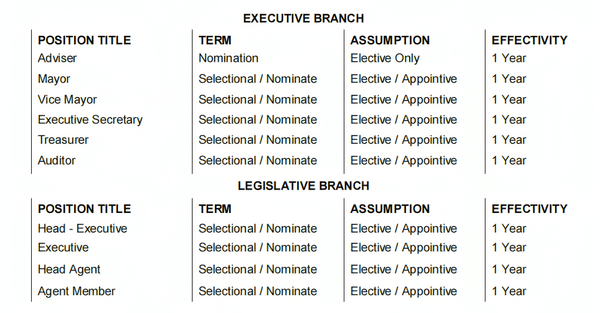
Section 5. Reshuffling of the organization from the composition of officers and service operations must be a routine practice annually.
Section 6. The duration of office of every officers shall only be at least 1 year, this applies to all officers ranking from Executive Branch and Legislative Branch.
ARTICLE VI
DUTIES AND RESPONSIBILITIES OF THE AIDO OFFICERS
Section 1. The AIDO Mayor - The Mayor shall serve as the highest executive officer of the Aurum Innovations and Development Organization (AIDO) and shall have full authority over the supervision, direction, and control of the organization’s operations and affairs. The Mayor shall perform the following duties and responsibilities:
-
Preside over all internal organizational meetings, including both regular and special sessions.
-
Formulate, implement, and execute strategic plans, policies, and programs in pursuit of AIDO’s goals and objectives.
-
Exercise leadership in the overall management and administration of the organization, ensuring the effective and efficient delivery of services.
-
Represent AIDO in all official functions, partnerships, negotiations, and engagements with external entities, including government offices, institutional partners, and stakeholders.
-
Ensure compliance with all applicable university rules, national laws, and internal organizational policies.
-
Oversee the preparation and submission of regular reports regarding the organization’s operations, programs, and financial standing to the Executive Committee and other relevant bodies.
-
Direct the allocation and utilization of AIDO resources in accordance with approved plans and budgets.
-
Promote and uphold a culture of professionalism, innovation, ethical service, and integrity within the organization.
-
Act as the primary liaison between the Executive Officers and the organization’s general membership, facilitating clear communication and implementation of executive decisions.
-
Lead organizational efforts in resource mobilization, partnership development, and external networking to support and sustain AIDO’s programs and initiatives.
-
Perform any other duties necessary for the effective governance and operations of AIDO or as may be assigned by the Executive Committee, OSWD, or other governing bodies of the university.
-
Be held accountable for the overall performance, direction, and sustainability of AIDO in accordance with the organization's Constitution and By-Laws, and the policies of NEMSU.
Section 2. The AIDO Vice Mayor - The Vice Mayor shall serve as the second-highest executive officer of the Aurum Innovations and Development Organization (AIDO) and shall perform the following duties and responsibilities:
-
Serve as the immediate successor to the Mayor and assume full authority over the organization’s operations in the event of the Mayor’s absence, incapacity, or delegation of duties. The Vice Mayor shall carry out all pending tasks, responsibilities, and official business that require resolution.
-
Assist the Mayor in any organizational activities, official affairs, or events where the presence and support of the Vice Mayor are required.
-
Supervise and guide members in the planning and coordination of activities, meetings, and programs to ensure smooth implementation and adherence to organizational goals.
-
Perform additional duties or special assignments delegated by the Mayor or the official AIDO Adviser.
-
Follow and uphold all directives issued by the Mayor in accordance with the organizational chain of command and internal protocols.
Section 3. The AIDO Executive Secretary - The Executive Secretary shall be responsible for maintaining efficient administrative operations within the Aurum Innovations and Development Organization (AIDO) and shall perform the following duties and responsibilities:
-
Receive, document, and respond to all official communications addressed to the organization, including phone calls, emails, letters, and other correspondence.
-
Manage and organize the organization’s calendar, including scheduling meetings, appointments, and important events involving the Mayor, Executive Officers, and committees.
-
Arrange and coordinate professional workspaces, meeting venues, and special organizational activities requiring logistical planning.
-
Record and keep accurate minutes of all official meetings, ensuring that summaries are well-documented and submitted to the appropriate offices.
-
Communicate and negotiate with suppliers and distributors for quotations, procurement of materials, and maintenance of office inventory and logistical needs.
-
Prepare and manage various official documents such as financial statements, invoices, formal letters, internal memos, and reports.
-
Disseminate official communications, announcements, and organizational reports to all relevant members, officers, and university stakeholders.
-
Certify, prepare, organize, and receive documents officially issued by or for the Aurum Innovations and Development Organization (AIDO), ensuring their proper handling, filing, and coordination in accordance with university procedures.
Section 4. The AIDO Treasurer - The Treasurer shall serve as the chief financial officer of the Aurum Innovations and Development Organization (AIDO) and shall be responsible for overseeing all financial matters of the organization. The Treasurer shall perform the following duties and responsibilities:
-
Manage and safeguard all funds and financial assets of AIDO, ensuring proper accounting and transparency in all financial transactions.
-
Prepare, maintain, and update accurate records of income, expenditures, cash flows, and account balances.
-
Develop financial plans and propose annual budgets in coordination with the Mayor and other Executive Officers for approval by the organization.
-
Process and monitor disbursements of funds in accordance with approved projects and ensure all payments are properly documented with receipts or vouchers.
-
Prepare and present regular financial reports, including statements of accounts, to the Executive Officers, members, and, when required, to the Office of Student Welfare and Development (OSWD).
-
Ensure that all financial activities comply with university financial policies, regulations, and audit requirements.
-
Coordinate with the Executive Secretary in the preparation of invoices, receipts, and other financial documentation.
-
Assist in fundraising activities, income-generating projects, and financial planning to sustain the operational needs of AIDO.
-
Submit all financial records for internal and external auditing upon request by the organization or the university.
-
Perform other financial duties as may be assigned by the Mayor or required by university authorities.
Section 5. The AIDO Auditor - The Auditor shall be responsible for independently examining and verifying the financial activities and records of the Aurum Innovations and Development Organization (AIDO) to ensure transparency, accountability, and compliance with institutional policies and accounting standards. The Auditor shall perform the following duties and responsibilities:
-
Examine and verify the accuracy and fairness of AIDO’s financial statements, including the balance sheet, income statement, and cash flow reports.
-
Perform internal auditing procedures to ensure the accuracy, completeness, and integrity of all financial transactions and records.
-
Analyze and validate financial reports, accounts, receipts, and disbursements to identify discrepancies or potential errors.
-
Conduct periodic audits of AIDO’s financial and operational processes to ensure compliance with university policies, organizational bylaws, and relevant financial regulations.
-
Assess the effectiveness of internal control systems and recommend improvements to strengthen financial safeguards and reduce operational risks.
-
Prepare comprehensive audit reports outlining findings, irregularities, and recommendations for corrective actions.
-
Monitor compliance with generally accepted accounting principles (GAAP) and other financial standards applicable to student organizations.
-
Provide consultation and technical guidance to officers regarding financial policies, documentation, and auditing practices.
-
Review financial transactions to detect instances of mismanagement, inefficiencies, or fraudulent activities.
-
Assist external auditors or university auditors during official reviews by furnishing required documents and justifications.
-
Maintain accurate records and documentation of all auditing procedures, results, and related correspondence.
-
Continuously update knowledge on current auditing standards, financial regulations, and best practices through professional development.
-
Ensure the financial transparency, accountability, and integrity of AIDO’s operations and perform other auditing duties as may be assigned by the Mayor or the Executive Officers.
Section 6. The AIDO Head-Executive - The Head-Executive shall serve as the presiding officer of the Legislative Branch of the Aurum Innovations and Development Organization (AIDO) and shall act as an Ex-Officio member of the Executive Branch. The Head-Executive shall perform the following duties and responsibilities:
-
Preside over all regular and special meetings of the Legislative Branch, ensuring orderly proceedings and adherence to internal rules of order.
-
Exercise leadership over the operations and coordination of the Legislative Branch, including the supervision of members, legislative proposals, and organizational resolutions.
-
Function as an Ex-Officio member of the Executive Branch, maintaining a direct line of collaboration and communication between the legislative and executive bodies.
-
Oversee the day-to-day operations of the organization’s divisions to ensure consistency with the legislative framework and organizational objectives.
-
Ensure that all organizational activities and decisions comply with university policies, national regulations, and AIDO’s internal rules and bylaws.
-
Manage and guide the organization toward achieving its approved goals and developmental objectives through coordinated oversight.
-
Lead the implementation of strategic direction and proposed plans approved by the legislative or executive body.
-
Collaborate with executive officers in considering major organizational decisions, including partnerships, structural changes, and organizational expansions.
-
Serve as a representative of AIDO to the Executive Board, student government, general membership, partners, and the broader university community.
Section 7. The AIDO Executive - The Executive Officers of the Aurum Innovations and Development Organization (AIDO) shall be responsible for supporting the leadership, administration, and operational functions of the organization in alignment with its goals, mission, and governing policies. Each Executive shall perform the following duties and responsibilities within their respective areas of assignment:
-
Support the overall leadership and management functions of AIDO by performing specialized duties that align with organizational objectives and uphold the values of innovation and development.
-
Actively participate in the formulation, implementation, and evaluation of organizational policies, programs, and strategic plans.
-
Supervise and manage the day-to-day operations of their assigned departments or units to ensure efficient and effective service delivery.
-
Collaborate with fellow executives and committee heads to promote interdepartmental coordination and organizational synergy.
-
Monitor the performance of members or volunteers under their supervision, providing mentorship, feedback, and support as needed.
-
Contribute to the planning and management of the organization’s budget, ensuring that all resources are allocated and utilized responsibly.
-
Serve as a communication link between the Executive Branch and other branches, committees, or external stakeholders.
-
Implement official directives, programs, and resolutions issued by the Mayor, Head-Executive, or other authorized governing officers of AIDO.
-
Represent AIDO in university-sanctioned meetings, forums, training, conferences, and official functions when delegated.
-
Identify operational concerns or inefficiencies within their departments and recommend viable solutions to improve performance and organizational impact.
-
Perform additional tasks or assignments as directed by the Mayor or Executive Leadership to ensure the continued success and functionality of the organization.
-
Remain accountable for advancing AIDO’s mission and values by exhibiting effective leadership, innovation, and integrity within their respective areas of responsibility.
Section 8. Committee Head Agent - The Committee Head Agent shall serve as the leader of a designated committee within the Aurum Innovations and Development Organization (AIDO) and shall operate under the jurisdiction and guidance of the Executive Officers or the AIDO Mayor. The Committee Head Agent shall perform the following duties and responsibilities:
-
Lead and supervise the operations, tasks, and activities of their assigned committee, ensuring alignment with the overall goals and objectives of AIDO.
-
Coordinate directly with the Mayor or designated Executive Officers regarding committee updates, progress reports, and implementation of assigned initiatives.
-
Delegate responsibilities to Committee Agent Members and ensure the timely and effective completion of all assigned tasks and projects.
-
Organize and preside over internal committee meetings to plan, monitor, and evaluate committee work.
-
Serve as the committee’s official representative in Executive Branch meetings or when reporting to the organization’s leadership.
-
Ensure that all committee actions, outputs, and documentation are aligned with AIDO’s operational standards, university policies, and ethical guidelines.
-
Submit periodic reports summarizing accomplishments, issues, and recommendations to the appropriate Executive or the AIDO Mayor.
-
Foster teamwork, professionalism, and initiative among Committee Agent Members.
-
Perform other duties as may be assigned by the Executive Branch or the AIDO Mayor in relation to the committee’s function and responsibilities.
Section 9. Committee Agent Member - The Committee Agent Member shall serve as an active officer within a specific committee of the Aurum Innovations and Development Organization (AIDO) and shall directly report to the Committee Head Agent, under the jurisdiction of the Executive Officers or the AIDO Mayor. Committee Agent Members shall perform the following duties and responsibilities:
-
Carry out assigned tasks and responsibilities delegated by the Committee Head Agent or any authorized Executive Officer, ensuring that such tasks contribute to the success of AIDO’s programs and initiatives.
-
Participate actively in committee operations, including meetings, planning sessions, and implementation of activities.
-
Support the execution of projects, events, and services aligned with AIDO’s focus on innovation, research, partnerships, and technological development.
-
Uphold professionalism, accountability, and ethical conduct in all committee-related duties.
-
Maintain consistent communication with the Committee Head Agent regarding task progress, concerns, or proposed improvements.
-
Assist in the preparation of reports, documentation, and evaluations as needed by the committee or requested by the Executive Branch.
-
Demonstrate commitment to the organization’s vision and goals, and serve as a positive example to fellow members.
-
Perform other related functions as may be assigned by the Committee Head Agent, Executive Officers, or the AIDO Mayor.
Section 10. The Ex-Officio Members shall represent their respective branches and shall reiterate the information from the Executive Branch to their respective branches. But can also have the same power as the Executives.
Section 11. The AIDO Adviser shall have the following duties and responsibilities as state:
-
The AIDO shall have an adviser to be nominated and duly be concurred as per recommendation of all officers of the organization.
-
The Adviser shall assist the AIDO in the performance of its functions, operations, and other related terms of technical support.
-
The Adviser shall sign and approve all important documents submitted to him/her by the AIDO Officers, specifically the documents must be submitted by the Executive Secretary of the Organization. To ensure it’s legitimacy.
Section 12. Assignment of Agents - The AIDG Agents excluding the Operative III and the Operative II as they have separated functions, each agents shall be assigned to each committees in the Legislative Branch and the highly trained agents will be automatically and immediately be assigned in the Executive Branch.
ARTICLE VII
COMPOSITION OF SEPARATED INTERNAL OFFICES OF THE AIDO AND IT’S COMMITTEE FUNCTIONS
Section 1. Purpose of Committees - Committees serve as essential components of the Aurum Innovations and Development Organization (AIDO), contributing to the organization's efficient and effective operation. Each committee plays a vital role in facilitating internal communication, assisting leadership in the decision-making process, and providing the necessary information, strategies, and support to ensure the success of organizational programs, services, and initiatives.
Section 2. Official Committees of AIDO - AIDO shall establish and maintain the following official committees:
-
Committee on Internal Affairs. (CIA)
-
Committee on External Affairs. (CEA)
-
Committee on Biometric Systems. (CBS)
-
Committee on Publication and Communications. (CPC)
-
Committee on Partnerships and Agreements. (CPA)
-
Committee on Research and Development Unit. (CRDU)
Section 3. Purpose of Internal Offices - The internal offices of AIDO are designed to strengthen the execution of core duties and responsibilities by providing structured governance, promoting operational efficiency, and enhancing organizational performance. These offices enable smoother internal coordination, streamlined workflows, and strategic implementation of the organization's programs and policies.
Section 4. Official Internal Offices and Domicile - AIDO shall maintain two distinct internal offices:
-
Office of the Aurum Executive Branch. (OAEB)
-
Office of the Aurum Legislative Executives. (OALE)
ARTICLE VIII
FUNCTIONS, DUTIES AND RESPONSIBLITIES OF THE COMMITTEE AND COMMITTEE MEMBERS
Section 1. Committee Executive Chairperson - The Committee Executive Chairperson shall be an official AIDO Executive Officer who is designated as the lead chairperson of the committee to which they are assigned. They are responsible for supervising all committee activities, making key decisions, and reporting directly to the Mayor or appropriate branch.
Section 2. Committee Executive Deputy - The Committee Executive Deputy shall be the second-in-command within the committee and shall assist the Chairperson in fulfilling the committee's mandates. The Deputy shall be responsible for executing tasks and assignments in support of the committee’s objectives.
Section 3. Committee on Internal Affairs - Responsible for conflict resolution, student organization registration support, internal information dissemination, logistical assistance, review of organizational by-laws and policies, processing membership applications, handling appeals, and supporting the General Assembly.
Section 4. Committee on External Affairs - Handles external legislative matters, reviews demands for grants, proposes long-term external engagement strategies, and manages relations with foreign organizations, institutions, and media partners. Also oversees public relations, communications policy implementation, and the execution of outreach programs.
Section 5. Committee on Biometric Systems - The Committee on Committee on Biometric Systems (CBS) is responsible for overseeing and managing all digital and computerized systems within the Aurum Innovations and Development Organization (AIDO). This includes system maintenance, database management, cybersecurity protocols, data analysis, digital reporting, and technical support. The committee ensures that all organizational data and digital resources are secure, efficient, and properly utilized in support of AIDO’s programs and services.
Section 6. Committee on Publication and Communications - The Committee on Media Publication and Communications is responsible for managing the organization's media presence and publications, including establishing and maintaining media relations, overseeing publications, managing social media, coordinating press coverage, facilitating internal and external communication, ensuring event coverage, providing media training, monitoring media coverage, and developing media policies and procedures.
Section 7. Committee on Partnership and Agreements - The Committee on Partnership and Agreements is responsible for enhancing collaboration, strategic alignment, resource management, risk management, continuous improvement, partnership selection, partnership management, communication, monitoring and evaluation, and strategic planning.
Section 8. Committee on Research and Development Unit - The Committee on Research and Development primarily focuses on research, innovation, and advancements. This committee will only be occupied to the AIDG Operative Branch which all of officers of that branch with the Mayor as head chairman of the committee.
Section 9. Office of the Aurum Executive Branch. (OAEB) Functions: The OAEB is responsible for improving office duties and responsibilities, enhancing efficiency and performance, and ensuring the smooth operation of the organization and shall compose the set officers as stated:
-
Mayor.
-
Vice Mayor.
-
Executive Secretary.
-
Treasurer.
-
Auditor.
-
Ex-Officio Officers
Section 10. Office of the Aurum Legislative Executives. (OALE) Functions: This office oversees the ongoing operations of all divisions in the organization, ensures compliance with laws and regulations, manages and directs the company towards its goals, and leads major decision-making processes. It also promotes communication and cooperation among divisions, monitors performance, and maintains accountability with the board of executives shall compose the set officers as stated:
-
Head - Executive.
-
Executives.
-
Agents
-
Ex-Officio Officers
Section 11. The AIDO has total authority to create another committee through a resolution and must be conformed by the legislative and be approved by the executive branch. The process of creating a new committee will not be permanent but be temporary unless if it is added in the Systematic Code and Bylaws of this AIDO.
ARTICLE IX
BUREAUCRATIC NOMINATION ON APPOINTIVE AND ELECTIVE POSITIONS
Section 1. Appointive and Elective Positions - The elective and appointive positions of the Aurum Innovations and Development Organization (AIDO) are defined as follows:
a) Mayor
b) Vice Mayor
c) Executive Secretary
d) Treasurer
e) Auditor
f) Head - Executive
g) Executive
h) Committee Head Agent
i) Committee Agent Member
Section 2. Filling of Vacant Positions - If the positions have no nominees and are not filled, the AIDO Mayor is obligated to search and recruit any students who are interested to join the organization. Upon this action, the AIDO Mayor will process their appointments in accordance with the appointive process.
Section 3. Requirements for AIDO Official - The requirements for AIDO Official application are as stated:
a) 1x1 Picture - Soft Copy.
b) Application Form.
c) Student ID Number.
d) Certificate of Registration.
e) One (1) Semestral Residency.
f) Code of Honor. (To be approved by the AIDG Mayor & Adviser)
Section 4. Election Process - The election process within the Aurum Innovations and Development Organization (AIDO) shall be democratic, transparent, and inclusive, as outlined below:
a) Nomination Process: All recognized members of AIDO have the full right to nominate any eligible individual for a specific position within the organization. In the absence of external nominations, individuals may nominate themselves for any position of interest. Nominations shall be submitted prior to the election assembly or declared during the meeting, as permitted.
b) Electional Process: All nominated individuals shall participate in an organized election meeting convened in the presence of the AIDO Mayor and the Official Adviser. During the session, nominees will openly declare or negotiate their preferred positions under either the Executive or Legislative Branches.
c) Conduct of Voting: Voting shall be conducted through on-the-spot voting, wherein the nominees will cast votes by raising their hands as each candidate's name is called. Only nominees are allowed to vote. Votes shall be counted in real time, and the candidate receiving the majority of affirmative votes shall be declared the winner for that position. Immediately following the vote, the AIDO Mayor shall formally announce the elected officer, whose assumption of duty takes effect at once, pending the completion of the turnover process.
Section 5. Appointive Process - In the event that vacancies remain within either the Executive or Legislative Branches of the organization after the election process, the AIDO Mayor shall be authorized and obligated to appoint qualified and willing students from within North Eastern Mindanao State University (NEMSU) to fill the vacant positions. Both current and outgoing officers may recommend individuals for appointment, provided such recommendations are submitted with the consent and approval of the AIDO Mayor. All appointments shall follow proper documentation and be formalized by an internal resolution or appointment order.
Section 6. Assumption to Office - All elected or appointed officers shall formally assume their respective positions following the successful completion of a turnover process conducted by the outgoing officers. A Succession Meeting must be convened to legalize the transition of authority, during which a formal Resolution of Assumption shall be drafted, signed, and passed to confirm the new leadership.
Section 7. Emergency Succession Protocol - In the event that the organization fails to conduct the necessary meetings or complete the required appointment or succession processes due to inaction or obstruction, the organization shall implement an Emergency Succession Protocol to ensure the continuity of operations. This protocol may only be enacted under the following conditions:
a) Failure to Conduct Succession: If the outgoing officers or concerned committees fail to organize the required succession meeting or complete the turnover of responsibilities within a reasonable timeframe, an Executive Directive may be issued by the presiding head of the organization to facilitate the immediate appointment or assumption of office. This directive shall carry full authority equivalent to a formal resolution.
b) Obstruction or Monopolization of Process: In circumstances where it is determined that certain individuals or groups within the organization are deliberately obstructing the succession or appointment process—such as through monopolization, exclusion, or manipulation—an internal reorganization may be authorized. This reorganization must be executed in accordance with the guiding principles of fairness, inclusivity, and organizational stability.
ARTICLE X
MEETINGS, QOURUM, INTERNAL AND EXTERNAL RULES
Section 1. Frequency of Meetings - The Aurum Innovations and Development Organization (AIDO) shall conduct at least one (1) regular meeting per month, in addition to any number of special meetings as necessary. This regular cadence ensures that the organization remains engaged, responsive, and actively aligned with its goals and programs.
Section 2. Meeting Procedures and Guidelines - AIDO meetings shall be governed by established internal procedures to ensure order, clarity, and efficiency. Two categories of procedural rules shall be developed:
-
Internal Rules: These govern meetings involving internal members and must be drafted and approved by AIDO members.
-
External Rules: In cases involving meetings with external, non-university-affiliated partners, the AIDO membership, with the guidance of the AIDO Adviser, shall draft a separate external meeting guideline to ensure coordination and professionalism.
Section 3. Internal Rules Framework - A comprehensive set of Internal Rules (IR) shall be drafted and formalized through an approved resolution. These rules shall serve as the official framework for internal meetings and operations and must be agreed upon by the majority of members present during their ratification.
Section 4. Amendments to Internal Rules - The Internal Rules may be amended annually, but only in relation to updates in the Systemic Code and By-Laws. This annual limit ensures consistency, prevents arbitrary changes, and protects the integrity and continuity of the organization’s internal procedures.
Section 5. Duties of the Executive Secretary in Meetings - The Executive Secretary shall be responsible for preparing all meeting-related documentation in accordance with the Internal Rules. This includes, but is not limited to:
-
Minutes of meetings
-
Attendance records
-
Meeting notices
-
Reports
-
Internal memoranda
-
Other official organizational documents as required
Section 6. Meeting Protocols and Quorum Requirements - The AIDG follow the procedural instructions of the meeting as stated:
-
Meeting Quorum Order - Each type of meeting shall require a specific quorum to be officially recognized. Quorum requirements vary by meeting type, as specified below:
Types of Meetings:
-
Regular Meetings - Shall be presided over by the AIDO Mayor and require the presence of at least three (3) Executive Officers.
-
Special Meetings - Similar to regular meetings, these also require at least three (3) Executive Officers and the AIDO Mayor as the presiding officer.
-
Executive Meetings - No minimum quorum is required. Meetings may proceed with any number of Executive Officers present, provided all decisions and discussions are properly documented and;
-
Legislative Meetings - The Legislative meeting shall have at least three (3) executives and with the presence of the Head-Executive as presiding officer.
-
Emergency Meetings - Shall be conducted based on the availability of members. Those who can be contacted and are able to attend shall form the temporary quorum. Emergency meetings must still be documented for transparency and accountability.
ARTICLE XI
MEETINGS, QOURUM, INTERNAL AND EXTERNAL RULES
Section 1. Frequency of Meetings - The Aurum Innovations and Development Organization (AIDO) shall conduct at least one (1) regular meeting per month, in addition to any number of special meetings as necessary. This regular cadence ensures that the organization remains engaged, responsive, and actively aligned with its goals and programs.
Section 2. Meeting Procedures and Guidelines - AIDO meetings shall be governed by established internal procedures to ensure order, clarity, and efficiency. Two categories of procedural rules shall be developed:
-
Internal Rules: These govern meetings involving internal members and must be drafted and approved by AIDO members.
-
External Rules: In cases involving meetings with external, non-university-affiliated partners, the AIDO membership, with the guidance of the AIDO Adviser, shall draft a separate external meeting guideline to ensure coordination and professionalism.
Section 3. Internal Rules Framework - A comprehensive set of Internal Rules (IR) shall be drafted and formalized through an approved resolution. These rules shall serve as the official framework for internal meetings and operations and must be agreed upon by the majority of members present during their ratification.
Section 4. Amendments to Internal Rules - The Internal Rules may be amended annually, but only in relation to updates in the Systemic Code and By-Laws. This annual limit ensures consistency, prevents arbitrary changes, and protects the integrity and continuity of the organization’s internal procedures.
Section 5. Duties of the Executive Secretary in Meetings - The Executive Secretary shall be responsible for preparing all meeting-related documentation in accordance with the Internal Rules. This includes, but is not limited to:
-
Minutes of meetings
-
Attendance records
-
Meeting notices
-
Reports
-
Internal memoranda
-
Other official organizational documents as required
Section 6. Meeting Protocols and Quorum Requirements - The AIDG follow the procedural instructions of the meeting as stated:
-
Meeting Quorum Order - Each type of meeting shall require a specific quorum to be officially recognized. Quorum requirements vary by meeting type, as specified below:
Types of Meetings:
-
Regular Meetings - Shall be presided over by the AIDO Mayor and require the presence of at least three (3) Executive Officers.
-
Special Meetings - Similar to regular meetings, these also require at least three (3) Executive Officers and the AIDO Mayor as the presiding officer.
-
Executive Meetings - No minimum quorum is required. Meetings may proceed with any number of Executive Officers present, provided all decisions and discussions are properly documented and;
-
Legislative Meetings - The Legislative meeting shall have at least three (3) executives and with the presence of the Head-Executive as presiding officer.
-
Emergency Meetings - Shall be conducted based on the availability of members. Those who can be contacted and are able to attend shall form the temporary quorum. Emergency meetings must still be documented for transparency and accountability.
ARTICLE XII
GREVIANCE PROCEDURES AND LEGAL PROCESS
Section 1. Filing of Complaints – Any student, faculty member, staff, or member of the Aurum Innovations and Development Organization (AIDO) may file a written complaint concerning an alleged violation of university rules, organizational policies, or the Constitution and By-Laws. The complaint must clearly state the facts, the specific rule or policy allegedly violated, and must be supported by documentary or testimonial evidence. Complaints shall be submitted to the proper office or designated grievance authority, with an acknowledgment receipt issued to the complainant.
Section 2. Preliminary Investigation – Upon receipt of a complaint, the designated Grievance Committee or authorized official shall conduct a fact-finding review to determine whether there is sufficient basis to proceed. This may include interviewing involved parties, gathering supporting documents, and securing witness statements. The results of this review will determine if the matter warrants formal proceedings.
Section 3. Formal Hearing – If the case proceeds, a formal hearing shall be scheduled with due notice to both the complainant and respondent. Each party will have the opportunity to present statements, submit documentary evidence, and call witnesses. Hearings must be conducted fairly and impartially, with minutes taken and all proceedings documented.
Section 4. Decision – After the hearing, the deciding body shall deliberate and issue a written resolution stating the findings of fact, the applicable rules or provisions, and the penalties or remedies to be imposed if liability is established. The resolution shall be signed by the deciding body and furnished to both parties.
Section 5. Appeal – The aggrieved party may file an appeal to the next higher authority within the organization or university within the prescribed period stated in policy. The decision on the appeal shall be final within the AIDO, without prejudice to further remedies under university rules.
Section 6. Procedural Flow:
-
Filing of Complaint – Complainant prepares and submits a written complaint with supporting evidence to the designated authority.
-
Acknowledgment – Complaint is officially received, recorded, and an acknowledgment receipt is issued.
-
Preliminary Investigation – Designated authority reviews facts, interviews witnesses, and gathers supporting materials.
-
Evaluation – If evidence is insufficient, case may be dismissed with proper documentation. If sufficient, proceed to hearing.
-
Notice of Hearing – Written notice is sent to both parties specifying the date, time, and venue of the hearing.
-
Formal Hearing – Both parties present their side, submit evidence, and call witnesses; proceedings are recorded.
-
Deliberation – Deciding body evaluates all evidence and testimony.
-
Issuance of Decision – Written resolution with findings, violations, and penalties is served to both parties.
-
Appeal Process – If contested, aggrieved party submits a written appeal within the allowed period.
-
Final Decision – Appeal is resolved; decision becomes final and executory within AIDO.
ARTICLE XIII
PREPARATION AND CONDUCT OF ACTIVITIES, PROJECTS AND PROGRAMS
Section 1. Planning and Implementation of Activities: The Aurum Innovations and Development Organization (AIDO) officials shall draft their proposed activities, projects, and programs for the current semester. This plan shall outline the organization's goals, objectives, and strategies for the upcoming semester, and shall be reviewed and approved by the Office of the Student Welfare and Development (OSWD). The plan shall also include a detailed budget and timeline for the implementation of the activities, projects, and programs. Furthermore, any activity to be conducted by the organization shall comply with the Consolidated Calendar of Program Activities (CCPA), also known as the Calendar of Activities, to ensure proper scheduling and alignment with institutional guidelines.
Section 2. Coordination and Collaboration: The AIDO officers shall coordinate with the different clubs or organizations' chairmen, moderators, and officers to implement their activities and projects. This coordination shall ensure that all activities and projects are aligned with the organization's goals and objectives, and that all stakeholders are informed and involved in the planning and implementation process. The AIDO shall also establish a system for sharing information and resources with other organizations to promote collaboration and avoid duplication of efforts.
Section 3. Evaluation and Monitoring: The AIDO shall evaluate its activities, programs, and projects on a monthly basis, and submit a report on its performance before the current year ends. This report shall include an assessment of the organization's progress towards its goals and objectives, as well as any challenges or obstacles that were encountered during the reporting period. The report shall also include recommendations for improvements and adjustments to the organization's plans and strategies.
Section 4. Proposal and Approval: The AIDO shall propose its projects or programs to the Office of the Student Welfare and Development (OSWD) and undergo the proper procedure when presenting them. The objective is to have the plans implemented, and the SSI shall ensure that all necessary approvals and permissions are obtained before proceeding with the project or program. The AIDO shall also establish a system for tracking the status of its proposals and ensuring that they are being reviewed and approved in a timely manner.
Section 5. Resolutions and Compliance: The AIDO shall prepare and approve a formal resolution for every project, platform, or program prior to implementation. Any initiative that does not follow the prescribed procedures and lacks an approved resolution shall be considered non-compliant, and the responsible officers may be subject to review and appropriate administrative action. The AIDO shall ensure that all resolutions are accurately documented and securely filed, and that all relevant stakeholders are duly informed of the resolution and its provisions. The AIDO shall also establish a system for monitoring adherence to its resolutions and addressing any instances of non-compliance in a timely and proper manner.
Section 6. Proposal and Implementation: The AIDO must prepare and submit a proposal before implementing any plans that will benefit the student community. The proposal shall include a detailed description of the plan, its goals and objectives, and the resources and budget required to implement it. The AIDO shall ensure that all necessary approvals and permissions are obtained before proceeding with the plan. The AIDO shall also establish a system for monitoring the implementation of its plans and making necessary adjustments to ensure their success.
Section 7. Collaboration and Communication: If the AIDO receives an invitation for collaboration or merger from another organization, it shall coordinate with that organization and arrange a formal meeting or open forum to exchange information and maintain proper professional communication. Prior to entering into such a collaboration or merger, the AIDO shall prepare the necessary supporting documents, including a written agreement and an activity proposal, for review and approval by the Office of the Student Welfare and Development (OSWD). The AIDO shall ensure that all required agreements and contracts are duly signed, and that all stakeholders are informed of the collaboration or merger. The AIDO shall also establish a system for continuous communication and coordination with its collaborative partners to ensure the success of the partnership.
Section 8. Joint Partnership: If the AIDO intends to establish a joint partnership with another organization to implement shared goals and values, it shall first prepare a formal letter of intent, an activity proposal, and any other required supporting documents for submission to the Office of the Student Welfare and Development (OSWD) for approval. Only after obtaining OSWD’s approval may the AIDO proceed with formal communication and the execution of the partnership. The AIDO shall ensure that all necessary agreements and contracts are properly signed, and that all stakeholders are informed of the partnership. Additionally, the AIDO shall establish a system for monitoring the progress and evaluating the success of the partnership, making necessary adjustments to ensure its continued effectiveness.
Section 9. Reporting and Accountability: The AIDO shall submit a report on its activities, programs, and projects to the Office of the Student Welfare and Development (OSWD), and be accountable for its actions and decisions. The report shall include an assessment of the organization's progress towards its goals and objectives, as well as any challenges or obstacles that were encountered during the reporting period. The AIDO shall ensure that all necessary approvals and permissions are obtained before submitting the report. The AIDO shall also establish a system for receiving and addressing feedback and concerns from the student body and other stakeholders.
Section 10. Budgeting and Financial Management: The AIDO shall develop and maintain a comprehensive budget for its activities, programs, and projects. This budget shall be reviewed and approved by the Office of the Student Welfare and Development (OSWD) and the student body. The AIDO shall also establish financial controls and procedures to ensure the proper management and allocation of funds, and shall provide regular financial reports to the OSWD. The AIDO shall also explore opportunities for fundraising and securing additional funding to support its activities and initiatives.
Section 11. Training and Development: The AIDO shall provide training and development opportunities for its officers and members to ensure that they have the necessary skills and knowledge to effectively carry out their duties and responsibilities. This may include workshops, seminars, and mentorship programs, as well as opportunities for officers and members to attend conferences and other professional development events. The AIDO shall also establish a system for evaluating the effectiveness of its training and development programs and making necessary improvements. The AIDO shall also encourage its officers and members to share their knowledge and expertise with other organizations and the broader student community.
Section 12. Incidental Income Generating Operations: The AIDO may engage in income-generating projects, provided that such initiatives are approved by the Office of the Student Welfare and Development (OSWD). All income-generating activities must be supported by official documentation, including a duly approved resolution or executive order, and an accompanying activity proposal. The proceeds from these projects shall be allocated as organizational savings and may be used to support the organization’s programs, projects, and operational needs.
ARTICLE XIV
INTELLECTUAL PROPERTY AND PRIVACY PROTECTION POLICY
Section 1. Digital Assurance and Governance – The ownership and operation of the digital page of the Aurum Innovations and Development Organization (AIDO) shall be exclusively managed by authorized AIDO officials and an authorized representative of the NEMSU Information and Computer Technology (ICT) Department, and must adhere to the principles of digital governance. In accordance with Republic Act 10173, Section 11, the processing of personal information is permitted only if it complies with the Act and other applicable laws, upholding principles of transparency, legitimate purpose, and proportionality, with data collected for specified and legitimate purposes and processed accordingly; under Section 14, while the processing of personal information may be subcontracted, the personal information controller remains responsible for ensuring proper safeguards to maintain confidentiality, prevent unauthorized use, and ensure overall compliance with the law; as per Section 20, the controller must implement reasonable and appropriate organizational, physical, and technical measures to protect personal information from accidental or unlawful destruction, alteration, disclosure, or any other unlawful processing; pursuant to Section 21, the controller is accountable for all processing activities and must ensure lawful compliance; and as stated in Section 25, unauthorized processing of personal or sensitive personal information is strictly prohibited and subject to penalties.
Section 2. Organizational Assets – All records, documents, assets, and other properties of the AIDO are the exclusive property of the organization. These shall be managed, maintained, and safeguarded by duly authorized AIDO officials in accordance with organizational policies, digital governance protocols, and applicable university regulations. Access to such records and assets shall be limited to authorized personnel to ensure proper confidentiality, security, and accountability.
Section 3. Authorized Digital Managers – The official digital page of the AIDO must only be controlled and managed by the following officers:
-
AIDO Adviser
-
Mayor
-
Executive Secretary
-
Executive on Publication and Communications
-
Executive on Biometrics Systems
-
NEMSU–Tandag Main Campus
Section 4. Systematic and Official Website – The official website or URL link of the Aurum Innovations and Development Organization (AIDO) shall be designated as “https://aurumorganization.wixsite.com/aurum-intelligence-1” and shall be controlled solely by authorized AIDO officers. While the organization retains full operational control of the website, it shall remain under the oversight of the Office of the Student Welfare and Development (OSWD) to ensure compliance with institutional policies, transparency standards, and proper digital governance.
Section 5. Confidentiality of Records – All organizational documents of the AIDO must remain confidential. All incoming communications, resolutions, and other drafts that are not yet official must remain secured until they are ready for public release in accordance with the organization’s transparency and digital governance policies.
Section 6. Information and Recognition – In order to operate the official social media accounts of the Aurum Innovations and Development Organization (AIDO), the Mayor shall prepare a formal Letter of Information addressed to the Head of the Office of the Student Welfare and Development (OSWD), through the Information and Technology Officer. This letter shall serve to legalize and formally recognize the organization’s digital entity, ensuring its compliance with university policies, transparency standards, and digital governance protocols.
ARTICLE XV
INTERNAL AND EXTERNAL PARTNERSHIPS
Section 1. The Benefits of Internal Partnership – Internal partnerships are a crucial component of the Aurum Innovations and Development Organization (AIDO)’s collaborative efforts. By working together with other student organizations, the AIDO can enhance coordination, optimize resource utilization, and engage students more effectively. These partnerships serve as a catalyst for personal and professional growth, enabling students to acquire new competencies and expand their horizons. Moreover, they help strengthen the bond between student organizations and the university, creating a more nurturing and supportive campus environment.
Section 2. Diversifying Internal Partnership – The AIDO recognizes the importance of diversifying its internal partnership strategies to cater to the unique needs and aspirations of its collaborators. From joint projects that bring together the collective expertise and resources of multiple organizations to skill-sharing initiatives that empower students with knowledge and capabilities, the AIDO is committed to exploring a wide range of partnership models. Each modality offers distinct advantages, from enhanced coordination and resource optimization to the development of a more skilled and versatile student body.
Section 3. Optimizing Resource Utilization through Partnership – Resource sharing is a key component of effective internal partnership, enabling the AIDO and its partners to maximize the impact of their available assets. By sharing equipment, facilities, and expertise, organizations can reduce costs, enhance efficiency, and focus on their core objectives. This collaborative approach to resource management not only benefits the participating organizations but also sets an example of responsible stewardship and resource optimization for the entire student community.
Section 4. Empowering Students through Skill Sharing – The AIDO firmly believes that skill sharing is a powerful tool for empowering students and enhancing their capabilities. By engaging in skill-sharing initiatives with partner organizations, students can acquire new competencies, refine existing skills, and broaden their horizons. This exchange of knowledge and expertise not only enhances individual capabilities but also strengthens the overall skill set of the student community, positioning them for success in their future.
Section 5. External Partnership: Expanding Horizons and Opportunities – While internal partnerships are the cornerstone of the AIDO’s collaborative efforts, the organization also recognizes the value of external partnerships with non-recognized student organizations. By establishing strategic agreements and short-term collaborations with these entities, the AIDO can access new resources, expertise, and networks, enabling it to expand its reach and impact. However, before entering into any form of joint partnership, collaborative activity, or operational engagement, the AIDO must secure prior approval from the Office of the Student Welfare and Development (OSWD). The AIDO approaches external partnerships with a keen eye for alignment with its mission and goals, ensuring that these collaborations serve the best interests of its members and the university community as a whole.
Section 6. The Benefits of External Partnership – External partnerships offer a wealth of benefits to the AIDO and its members. By tapping into the resources and knowledge of non-recognized student organizations, the AIDO can enhance its own capabilities, broaden its horizons, and create new opportunities for its members. Any proposed external partnership, joint initiative, or collaborative operation must first be submitted to the OSWD for review and approval prior to implementation. These collaborations also serve to increase the AIDO’s visibility and recognition, both within the university and beyond, positioning it as a leader in student advocacy and empowerment.
Section 7. Embracing Partnership for a Brighter Future – The AIDO’s commitment to internal and external partnerships is a testament to its vision for a more connected, empowered, and successful student community. By creating a culture of collaboration and synergy, the AIDO is poised to lead the charge in creating a more nurturing and supportive campus environment.
ARTICLE XVI
OFFICIAL LOGO
Section 1. The AIDG Official Logo - The AID official header has this following contents:
-
Outer Hexagon Border - The outer hexagon serves as the barrier or shield of the organization. Symbolizing strength and initiatives.
-
Inner Hexagon Content - The inner hexagon serves as the firewall of protection and indestructibility. Symbolizing rarity and value.
-
Infinity Dragon - The infinity dragon serves as the main character of the organization and symbolizes leadership, command, and wealth.
Section 2. The Office of the Aurum Executive Branch (OAEB) Official Header are only for organization documents level and must have it’s resolved resolution by it’s design and classification.
Section 3. The Office of the Aurum Legislative Executives (OALE) Official Header are only for organization documents level and must have it’s resolved resolution by it’s design and classification.
Section 4. Logo Customization - The AIDG logo can be customized in the following purposes:
-
Organization Event Purposes.
-
University Event Purposes and;
-
Special Event Purposes.
ARTICLE XVII
AURUM LEGAL POSSESSION OF INVENTORIES AND RESOURCES
Section 1. The AIDO is authorized to possess the following specified resources as stated:
-
Monetary / Cash Reserves.
-
Solicitation Receivables.
-
Donated Goods.
Section 2. Clarification of the Stipulated Inventories and Resources of the AIDO and Their Purpose
-
Monetary / Cash Reserves – Funds accumulated from membership fees, fundraising activities, approved income-generating projects, or other authorized financial sources. These reserves are intended for the implementation of organizational activities, emergency expenses, and the support of approved projects and programs in alignment with the organization’s goals and OSWD-approved plans.
-
Solicitation Receivables – Monetary or in-kind contributions pledged by individuals, businesses, or partner organizations in response to formal solicitation letters approved by the OSWD. These receivables are earmarked for specific projects or events, as stated in the solicitation request, and must be properly documented and reported in compliance with financial transparency policies.
-
Donated Goods – Tangible items given to the organization without monetary exchange, such as equipment, supplies, materials, or products. These goods shall be utilized solely for organizational purposes, event needs, or distribution in community outreach activities, as approved by the OSWD, and must be inventoried for accountability and proper stewardship.
ARTICLE XVIII
CODE OF HONOR AND COMMITMENT AGREEMENT
Section 1. Obligations and Loyalty – Aurum Innovations and Development Organization (AIDO) officials are expected to execute their duties and responsibilities with the utmost care and diligence, demonstrating unwavering loyalty to the organization and its mission. They must always act in the best interests of the organization and its members, prioritizing transparency and accountability. By adhering to these principles, AIDO officials can ensure that their actions align with the organization's goals and values, preserving a culture of trust and respect.
Section 2. Ethical Standards – AIDO officials are required to adhere to the highest ethical standards in all their dealings, avoiding any conflicts of interest and disclosing any potential conflicts. They must respect the confidentiality of the organization's information and operations, ensuring that sensitive information is protected and only shared with authorized personnel. By upholding these ethical standards, AIDO officials can maintain the organization's reputation and credibility, building trust with stakeholders and the public.
Section 3. Conduct and Representation – AIDO officials have the responsibility to promote and represent the organization in a manner consistent with its mission and policies. They may inform students about the organization’s programs, services, and activities, and encourage participation in an official and transparent manner. All promotions, recruitment efforts, and referrals must be conducted without personal gain, commission, or any form of private compensation, in order to prevent conflicts of interest and ensure that all organizational activities remain non-commercial and compliant with OSWD policies.
Section 4. Resignation and Departure – If an AIDO official resigns or voluntarily leaves the organization, they relinquish all organizational roles, duties, and privileges associated with their position. As student organizations are not private businesses, no member or officer retains exclusive rights to the organization’s services, programs, or concepts. However, they remain bound by confidentiality obligations to protect the organization’s sensitive information and materials. Any misuse of organizational resources or intellectual property after departure may be subject to OSWD review and university disciplinary processes.
Section 5. Acknowledgment and Agreement – By signing this Code of Honor and Commitment Agreement, the AIDO official acknowledges and agrees to abide by all the terms and conditions outlined in this document. They understand that any violation of this agreement may result in disciplinary action, including suspension or removal from office. By adhering to this agreement, AIDO officials ensure that their actions align with the organization's goals and values, maintaining the organization's reputation and credibility.
Section 7. Code of Silence – The Code of Silence is a fundamental principle of the AIDO, ensuring that all information and activities within the organization remain confidential and protected. Any information shared within the AIDO, whether verbally or in writing, must be kept confidential. Disclosing unofficial information to anyone outside the organization is strictly prohibited. This includes all transactions, discussions, and decisions made within AIDO, as well as any sensitive information or intellectual property. By adhering to this code, AIDO officials maintain the trust and confidence of students and stakeholders, ensuring that the organization's reputation and integrity are protected.
Section 8. Industrial Capital Authority (ICA) of an AIDO Official – All AIDO officials are expected to understand fundamental organizational management principles and apply their skills and expertise to develop effective strategies for the organization. This includes identifying opportunities for growth, managing risks, and making informed decisions to advance the organization’s mission. By leveraging their knowledge and capabilities, AIDO officials contribute to the organization’s performance and success.
ARTICLE XIX
ORGANIZED DISTRIBUTION OF DOCUMENTS AND IT’S STANDARD PROCEDURES
Section 1. The Aurum Innovations and Development Organization (AIDO) shall always prepare in advance or ahead of time to ensure the organization executes its tasks firmly and smoothly, such as preparing the budget of the AIDO and drafting proposals in advance to execute plans correctly.
Section 2. The organization shall also post on the AIDO website all documentations, narratives, and reports for the public to observe and view, maintaining transparency and accountability.
Section 3. The organization shall reproduce the final summary of documents in at least four (4) sets of copies to be submitted to the following offices:
-
Office of the Aurum Executive Branch. (OAEB)
-
Office of the Aurum Legislative Executives. (OALE)
-
Office of the Student Welfare and Development (OSWD) and;
-
Office of the Campus Director. (OCD)
ARTICLE XX
AMENDMENTS AND REVISION OF ORGANIZATIONAL LAWS
Section 1. Proposal of Amendments: Amendments or revisions to this Systematic Code and By-Laws may be proposed by any of the following:
-
A member of the Executive Branch;
-
An Ex-Officio Member of the AIDG;
-
A member of the Legislative Branch.
Section 2. Amendment Process: Proposed amendments or revisions shall undergo the following procedure:
-
Submission of a proposal requiring the participation of all members from the Executive and Legislative;
-
Due Process procedures and deliberation of the amendments;
-
Preparation of a Minute of the Meeting, duly signed by the legislative members, executive members, and ex-officio members;
-
Drafting of a resolution by the legislative branch concerning the proposed amendments or revisions;
-
Presentation of the resolution to the AIDG Adviser for approval;
-
Upon approval by the AIDG Adviser, the AIDG is obligated to the submission of the resolution to the Office of Student Welfare and Development (OSWD) for formal notification and information dissemination.
Section 3. Continuity of Existing Laws: All existing laws, memorandums, announcements, letters of instruction, and other issuances that do not conflict with this Systematic Code shall remain in effect until they are amended, repealed, or revoked.
Section 4. Endorsement of Proposal: Any proposal for amendment must be endorsed in writing at least one month prior to the regular session of the Legislative Chamber to allow adequate time for discussion and deliberation.
Section 5. Confirmation of the Amendments: Amendments or revisions shall only become effective after securing an affirmative vote of at least fifty percent plus one (50% + 1) by the Legislative Branch and to be finally approved by the Mayor in the Executive Branch.
Section 6. Effectivity of Amendments: Amendments of this Systematic Code and By-Laws shall take effect upon a confirmed votes by a majority of fifty percent plus one (50% + 1) of the total votes in the Legislative Branch.
Section 7. Duration of Amendments: This Systematic Code and By-Laws, including any approved amendments, shall take effect immediately or as specified in the approved resolution and shall remain in force for one (1) year before any further revisions or amendments may be proposed.
Section 8. Reboot and Reset Protocol: Incase that the organization becomes Non-Participative and Incapable to operate, the Mayor can Issue an Executive Order to immediately reset and select or appoint new nominees to vacate the remaining organizational positions.
ARTICLE XXI
DISSOLUTION AND RESET PROTOCOL
Section 1. Dissolution and Resetting – The organization may undergo dissolution or restructural reset only upon due process in coordination with, and with the approval of, the Office of the Student Welfare and Development (OSWD). Grounds for dissolution may include:
-
Re-naming the organization to better align with its mission and vision;
-
Resetting the organizational structure, policies, or strategic direction to enhance effectiveness;
-
Other significant matters as determined jointly by the Board of Executives, the Legislative Branch, and the OSWD; or
-
Prolonged inoperability due to the absence of functional officers or non-performance of organizational duties, as validated by the OSWD.
Section 2. Dissolution Effectivity and Asset Custody – Upon OSWD approval of dissolution, all funds, equipment, resources, and other properties of the AIDO shall remain as assets of the organization under university custody. These shall be turned over to the OSWD or other designated university offices for safekeeping, future use, or allocation to successor organizations or approved student programs. No individual member shall personally receive or claim organizational assets.
Section 3. Compliance and Documentation – The AIDO shall submit to the OSWD a complete dissolution report, including financial statements, inventory lists, and a copy of the approved dissolution resolution. The OSWD shall verify the accuracy of these documents and ensure proper disposition of assets.
Section 4. Asset Disposition Protocol – In compliance with university policy, the disposition of AIDO assets after dissolution shall follow these rules:
-
Primary Custody: All liquidated funds, materials, and properties are to be transferred to OSWD custody.
-
Future Allocation: OSWD shall reallocate these assets to successor organizations, student development programs, or university-approved projects.
-
Transparency: The final disposition of assets shall be documented in an OSWD public report to ensure accountability.
Section 5. Special Dissolution Authority – The dissolution process shall always involve OSWD oversight and approval. No single officer, including the AIDO Mayor, shall have sole authority to dissolve the organization or alter asset disposition without OSWD concurrence. In cases of severe dysfunction, misconduct, or breach of organizational governance, the OSWD may initiate dissolution proceedings in consultation with the AIDO Executive and Legislative branches. Any proposed modifications to the standard dissolution process must be justified in writing, approved by the OSWD, and documented for transparency.
Section 6. Dissolution by Resolution – The organization may be dissolved upon the formal presentation of a resolution endorsed by both the Executive Branch and the Legislative Branch. The resolution must be submitted to the OSWD for review and final approval before implementation.
Section 7. Dissolution by OSWD Directive – In cases where the organization is unable to establish a quorum or fulfill its basic operational functions, the OSWD may issue a directive to dissolve the AIDO. This decision shall be based on documented evidence of non-performance, misconduct, or inability to operate, and will follow due process to ensure fairness and transparency.
ARTICLE XXII
EFFECTIVITY OF THE SYSTEMATIC CODE AND BY-LAWS
Section 1. Effectivity Clause - The provisions of this Systematic Code and By-Laws of the Aurum Innovations and Development Organization (AIDO) shall take effect immediately upon approval by the majority vote of the organization’s governing body and concurrence of the organizational adviser, and upon ratification by the Office of Student Welfare and Development (OSWD) of North Eastern Mindanao State University – Tandag Main Campus.
Section 2. Amendments and Revisions - Any amendments, revisions, or modifications to this Code and By-Laws shall take effect only after compliance with the prescribed procedures for amendment, approval by the governing body, concurrence of the adviser, and ratification by the OSWD.
Section 3. Binding Force - Upon effectivity, all members, officers, committees, and organizational units of AIDO shall be bound to observe, comply with, and enforce the provisions contained in this Code and By-Laws without exception, subject to university rules and regulations.